
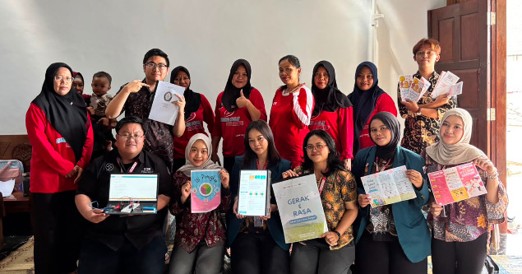
Dlepih, Wonogiri – Statistics students from Diponegoro University (UNDIP), through Team II of the 2026 Regular Community Service Program (KKN), introduced two data- and technology-based innovations for the community of Dlepih Village, Tirtomoyo District, Wonogiri Regency: an Excel-based digitization of Integrated Primary Services (ILP) data, and the SAHABAT BALITA application for screening children’s nutritional status. Both programs reflect a direct application of Statistics to support more structured and sustainable management of community health data in Dlepih Village.
The first program involved data collection and digitization of ILP records. The activity began with collecting and recording ILP-related information available in the village. The collected data was reviewed and systematically organized according to the required variables, making it easier to record, update, and retrieve in the future. Data previously recorded manually was transformed into a structured Microsoft Excel format, allowing users to input, update, and monitor information more efficiently. Students also guided relevant parties on data entry, updating, and management so the system could be used independently after the KKN program ended.
The second program, SAHABAT BALITA, was developed as a technology-based innovation to support the initial screening of children’s nutritional status using the Z-Score method based on WHO Child Growth Standards. The activities were held at two locations — Bengle Hamlet on August 3, 2026, and Dlepih Hamlet on August 11, 2026 — as part of Multidisciplinary Program 1 of Team II KKN UNDIP 2026, involving students from various academic disciplines. The activities began with child registration and anthropometric measurements, including body weight and height, which were then entered into the application for nutritional status screening. The results served as preliminary information to help Posyandu cadres and parents understand children’s growth conditions, with students assisting throughout the measurement, data entry, and explanation process.
Together, both programs demonstrate how data management knowledge can be applied to address real community needs — from primary health service administration to child growth monitoring. The ILP digitization is expected to improve administrative efficiency and information access, while SAHABAT BALITA is expected to encourage the sustainable use of data and technology in supporting child health. Through the collaboration between Team II KKN UNDIP and the Dlepih Village community, both innovations are expected to continue being used independently by relevant parties after the KKN program concludes.
Author: Berliana Tessa Shavira
Study Program: Statistics, Faculty of Science and Mathematics, Diponegoro University
Program: Multidisciplinary Work Program, KKN Team II, Diponegoro University, Academic Year 2025/2026
KKN Location: Dlepih Village, Tirtomoyo Subdistrict, Wonogiri Regency
Field Supervisors (DPL):
- Yuli Prasetyo Adhi, S.H., M.Kn. (NIP. 198107152006041001)
- apt. Almira Rahmayani, M.Pharm.Sci (NIP. 199601110126042008)
- Wildan Namora Ichsan Setiawan, S.I.Kom., M.Sc. (NPPU. H.7.199601012022101001)