

SEMARANG – The Department of Statistics, Faculty of Mathematics and Natural Sciences, Diponegoro University (Undip) remains committed to providing global standard education. Therefore, the annual Undip Global Classroom 2026 program was once again a success. This event featured an international lecture on Multivariate Statistics on Thursday, October 22, 2026. Furthermore, this session presents Dr. Adina Najwa Kamarudin. She is a statistician from the Institute of Mathematical Sciences, University of Malaya, Malaysia.
Theory and Application of Discriminant Analysis
In this expert lecture, Dr. Adina presented “Discrimination Analysis: Theory and Applications .” The session was dynamically designed and highly interactive. For example, the presentation combines theoretical frameworks, mathematical formulas, and computational simulations in the R language. In addition, there are interesting activities such as quick quizzes and waterfall chat discussions with students.
Beginning her presentation, Dr. Adina explained the fundamental differences between MANOVA and discriminant analysis. She emphasized the role of Linear Discriminant Analysis (LDA) in supervised learning modeling. Next, students are introduced to the concepts of pooled covariance and Mahalanobis distance. These concepts are essential for grouping data based on the characteristics of its explanatory variables.

Deep Understanding of Data Classification
Participants were also guided through hands-on numerical calculation exercises. The goal was to accurately predict sample categories. Furthermore, Dr. Adina reviewed a strategic comparison between LDA and Principal Component Analysis (PCA). She cautioned that PCA risks omitting crucial group-separating information. Therefore, a comparison of LDA and Quadratic Discriminant Analysis (QDA) is also presented as an appropriate alternative solution.
Model Validation and R Programming Practice
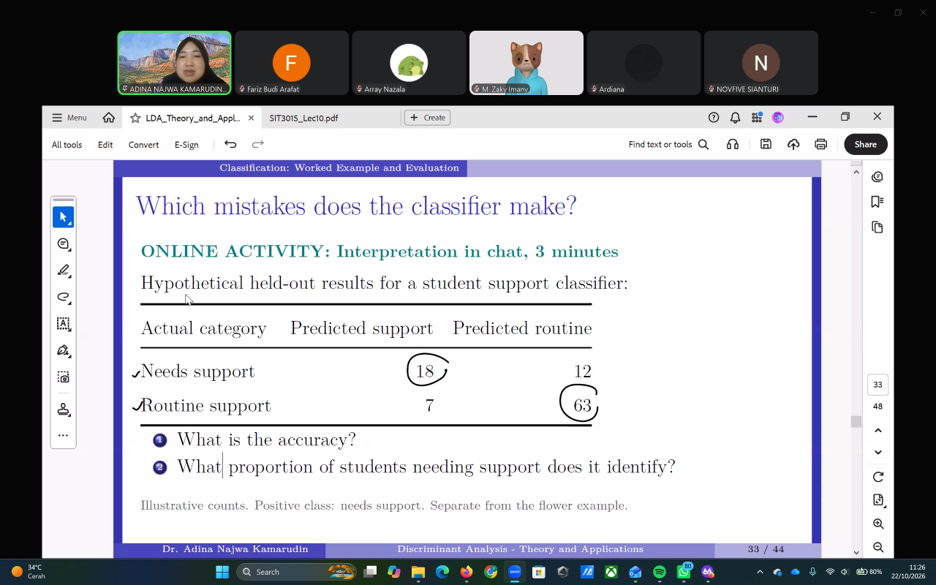
Next, the lecture continued with a discussion of model validation on new data. Dr. Adina warned about the dangers of the Apparent Error Rate (APER), which often produces overly optimistic results. As a solution, he introduced the Leave-One-Out Cross-Validation (LOO-CV) procedure. Confusion matrix evaluation is also measured using accuracy, sensitivity, and specificity metrics.
Finally, the material was reinforced with an R programming demonstration using the Iris dataset . Students were invited to directly observe the process of dividing training and testing data into two-dimensional visualizations. Ultimately, through the Undip Global Classroom, the Undip Statistics Department is committed to broadening students’ academic horizons. This high level of enthusiasm is expected to strengthen future research collaborations between Undip and Universiti Malaya.