
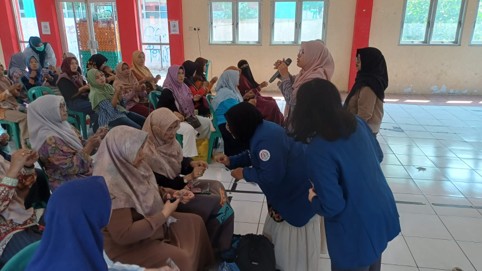
SEMARANG — The community service team from the Statistics Department, Faculty of Science and Mathematics (FSM), Diponegoro University (UNDIP), held a household waste management training at the Meteseh Village Hall in Tembalang District, Semarang City. The event, which took place on Saturday (August 22, 2026), demonstrated the university’s commitment to implementing the Tri Dharma of Higher Education.
Through this program, the community service team strives to raise public awareness of environmental cleanliness. Furthermore, this activity provides the community with practical skills for transforming everyday waste into useful and economically viable products. The event was met with great enthusiasm, with the presence of village officials, Family Empowerment and Welfare (PKK) cadres, and Meteseh Village residents.

Two Main Sessions of Waste Management Training
During the event, the community service team employed interactive methods to facilitate participants’ understanding of each topic. Therefore, the committee divided the event into two main sessions, focusing on organic and inorganic waste.
1. Making Compost from Household Kitchen Waste
In the first session, participants learned how to sort organic waste such as vegetable scraps, fruit peels, and food scraps. Next, the team of presenters demonstrated simple household composting techniques.
This method is odorless, making it easy for residents to implement in limited space. Later, residents can use the compost to fertilize their yard plants. This compost also supports urban farming programs in the surrounding area.
2. Decorative Flower Creations from Plastic Waste
Meanwhile, the second session addressed the high volume of plastic packaging and used bottle waste in the community. The team of presenters encouraged participants to process this inorganic waste into decorative flower crafts.
Participants practiced all stages of making, starting from cleaning, cutting patterns, forming petals, to tying flowers. Not only does this skill reduce environmental pollution, it also opens up creative business opportunities for housewives to increase their family income.
Turning Waste into Economic Resources
The Head of the Community Service Team explained that the selection of these two materials was based on actual conditions on the ground. Kitchen waste and plastic are the most common domestic problems in densely populated areas.
“Through this training, we hope that people will no longer view waste as an environmental burden, but rather as a resource that can be recycled. Kitchen waste can be returned to the soil to become plant nutrients, while plastic waste can be transformed into valuable works of art,” he said on the sidelines of the event.
Ultimately, the Statistics Department of the Faculty of Social and Political Sciences, Diponegoro University (UNDIP), hopes this waste management training will have a long-term impact on residents. Through integrated, community-based waste management, Meteseh Village can grow into a cleaner, more beautiful, and economically independent environment.